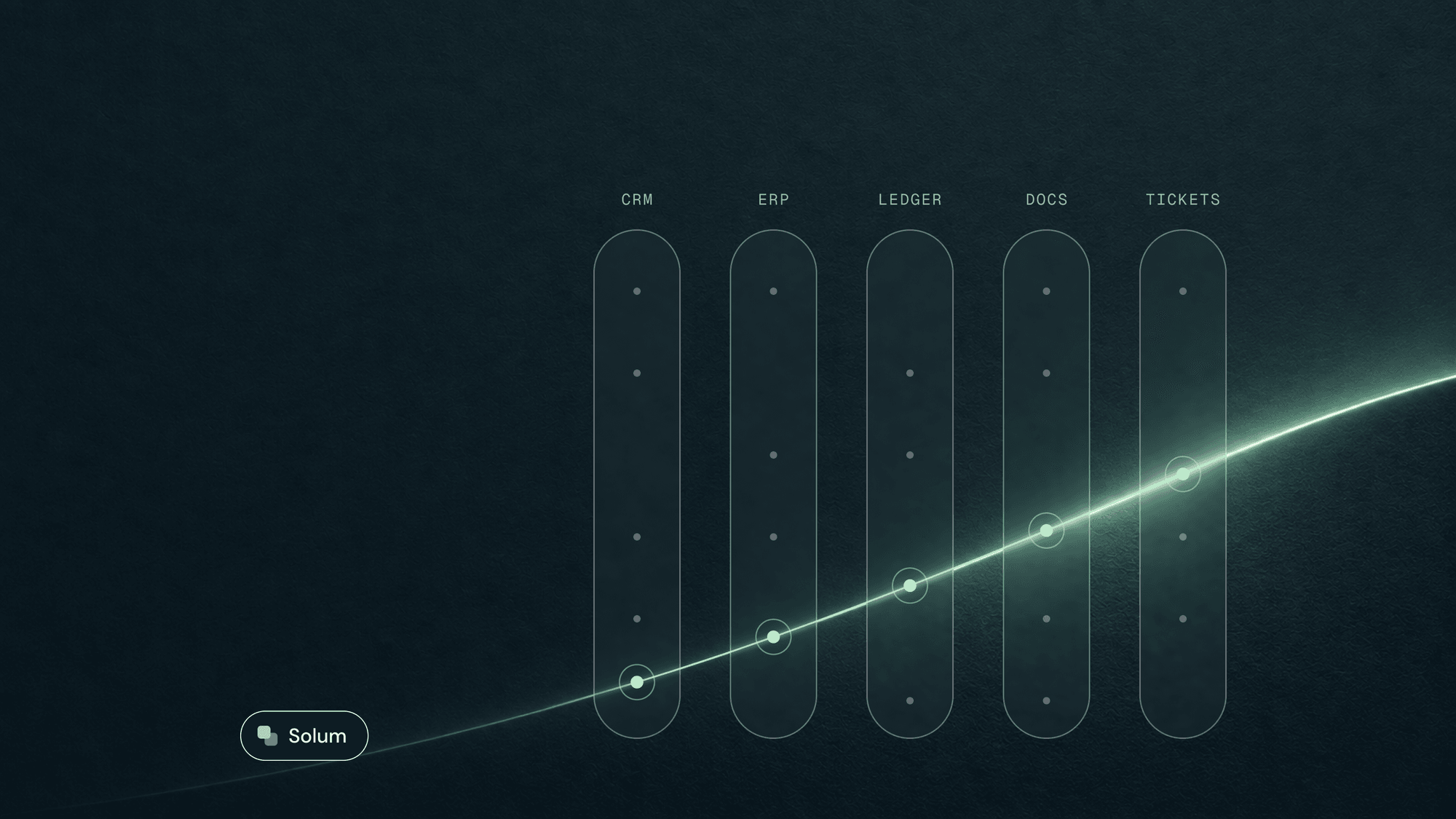
The pilot worked. A team connected a few systems, stitched enough documents into a prompt, and demoed answers leadership liked. Then the same pattern hit the rest of the organization. Production identities rejected the demo credentials. Finance and operations disagreed about what the same field meant. The answer that looked complete in a sandbox could not say which siloed store held the source of truth, or whether the requester was allowed to see it. The model class had not gotten smaller. The organization had never assembled connected, permissioned, silo-aware context.
That mismatch is the Context Scale Gap. Thin context wins the pilot. Enterprise rollout needs facts connected with sources and permissions, and retrieval that knows which store holds what. Syntel Solum closes that gap as the enterprise knowledge graph. Lumen sharpens what Solum retrieves by understanding data, domain, and where things live across silos.
If connected context stays incomplete, scaling the pilot only multiplies thin context. Spend becomes guessing with a better demo reel.
The Context Scale Gap
Hard statement, once: for the jump from pilot to production, a once-good-enough model is often not the bottleneck. Connected, permissioned, silo-aware context is.
Pilot context is thin on purpose. A few systems. A document set that fits in one team's workspace. Demo credentials that would never pass a production identity review. Enough local meaning for one use case, not for the adjacent ones waiting in the backlog. That thinness is why the pilot moves fast. It is also why org-wide rollout stalls.
Enterprise context asks for more on every axis at once. Facts have to be connected, not stitched together in a prompt each time someone asks a question. Connections need sources so operators can see where an answer came from. Permissions have to survive real access control, not the sandbox identity that made the demo safe. Retrieval has to know which siloed store holds the answer before it fetches, instead of hoping the right chunk landed in the window.
Those dimensions compound. Facts without connections force the prompt to do glue work that does not scale past one team. Connections without permissions fail the first production access review. Retrieval that does not know store location returns confident answers from the wrong system. Incomplete meaning makes the same field mean different things in finance and operations, so the graph retrieves the wrong slice even when permissions are correct.
The gap is the distance between the thin shape that won the pilot and the connected shape enterprise rollout requires. Treating "scale" as more users on the same thin stack buys larger models, larger windows, and another pilot. None of those moves assemble connected context.
The buyer decision changes here. Stop asking whether the demo worked. Ask how connected facts, permissions, and silo location stay in the retrieval path, and whether the vendor in front of you can answer at that layer.
Solum closes the gap
Solum is the enterprise knowledge foundation: connected business information through an ontology-based knowledge graph. For this piece, Solum is the closer. It keeps facts, sources, and permissions in one retrieval path, and knows which siloed store holds what.
Vector retrieval and document dumps can surface similar text at speed. That is a real capability, and enough for many local tasks. An ontology-based knowledge graph goes further: it connects business entities and relationships so the system can reason about what is linked to what, under which source, before it answers. Connected facts are the difference between finding a similar paragraph and traversing the relationships the business already runs on.
Intelligent retrieval is the second half. When a question lands, the path should know which system holds the answer, whether the requester can see it, and what source backs the fact. Location and access belong in retrieval, not as afterthoughts on a prompt. That keeps production identity inside the knowledge path instead of scaling a sandbox that was never safe.
Solum assembles what the pilot never did: knowledge graph, intelligent retrieval, and silo-aware fetch. Other portfolio products can support that closer. They do not replace it for this argument.
Lumen makes Solum retrieval accurate
Lumen is secondary here. Its job is shared understanding of enterprise data, which uses that data can support, and where things live, so Solum retrieval stays accurate across silos.
A knowledge graph that does not understand meaning will connect the wrong things with high confidence. Domain and feasibility judgment matter before fetch: which data products can support which decisions, and which definitions teams already disagree about. Lumen surfaces those disagreements instead of burying them in a clean-looking wrong answer.
When Lumen grounds domain and location, Solum has a smarter graph to walk: meaning upstream, connected facts and permissions downstream. Lumen does not close the Context Scale Gap on its own. Solum closes it. Lumen sharpens what Solum retrieves when the organization is large, siloed, and argumentative about definitions.
Won't a bigger window fix this?
A serious objection shows up in every enterprise review: if the model can take more tokens, why invest in a knowledge graph at all?
Window size is not the same as complete enterprise context. Liu et al., in "Lost in the Middle", showed that models do not reliably use evidence placed in the middle of long inputs even when that evidence is present in the window. A larger window can still fail to use what matters. It also cannot invent permissions, sources, or silo location that were never assembled into a connected graph.
Industry gravity points the same direction without answering the buyer question for you. Arvind Jain at Glean argued that context is the next data platform. Jaya Gupta and Ashu Garg at Foundation Capital framed context graphs as AI's trillion-dollar opportunity. Those theses describe where the industry is spending attention. What Syntel names is the Context Scale Gap, and what Solum closes is connected, permissioned, silo-aware context for organizations that already passed the pilot and stalled on rollout.
Buy the bigger window if latency and cost budgets allow. Do not confuse that purchase with assembling connected context. The window buys capacity. Solum assembles it.
Sovereign constraints make the gap harder
Closed models can feel absolute when the path is a public API, cloud credits, and a hosted endpoint you can point tools at. For many teams that path feels like control: pick a frontier model, wire the demo, move on. For sovereign clients the same path gets harder, not easier.
Sovereignty here is concrete. Deployment location, data access rules, and model choice are constraints the buyer sets, not preferences the vendor can ignore after the pilot. A closed SaaS model that feels unlimited in one environment can be a non-starter when the stack has to run under the client's control, with data access the client defines, and with model choice limited to what that constraint set allows.
This is not an AI-only problem. Closing connected context under those rules is engineering depth: making the knowledge path work on-prem and under sovereign constraints, on an owned stack the client can operate. The graph still has to land when you cannot treat someone else's hosted model as the default runtime. The Context Scale Gap does not shrink because the model is famous. It widens when the organization also has to own where the system runs and who can reach the data.
Syntel helps sovereign clients on that depth. Product and engineering treat deployment, data access, and model choice as first-class path design, not a footnote after the SaaS demo. Solum's job still holds under the rules the client actually has. A larger closed-model window does not become a sovereign knowledge graph on its own.
What a serious buyer asks
Peer questions, not a beginner checklist:
- Are facts connected with permissions, or stitched in the prompt?
- When retrieval runs, does the system know which siloed store holds the answer?
- Is data meaning, domain, and location understood before fetch (Lumen's job), or guessed at query time?
- Does the vendor offer a knowledge graph that closes connected context, or only a bigger window?
- If Solum (or an equivalent closer) is missing, what exactly are you scaling?
- Under your deployment and data-access rules, can the closer still run, or does the pitch assume a hosted path you cannot take?
If the answers stay vague, you are still funding thin context with a larger audience.
Close
Connected context is the scale layer. Solum closes it with an ontology-based knowledge graph and intelligent retrieval. Lumen keeps that retrieval accurate by grounding data meaning, domain, and location before the graph walks.
Before the next pilot budget lands, ask the vendor to show how connected facts and production permissions survive org-wide retrieval, and how the system knows which store to ask under the deployment and data-access rules you actually have. If they cannot show that closer in product, you are still buying a demo.